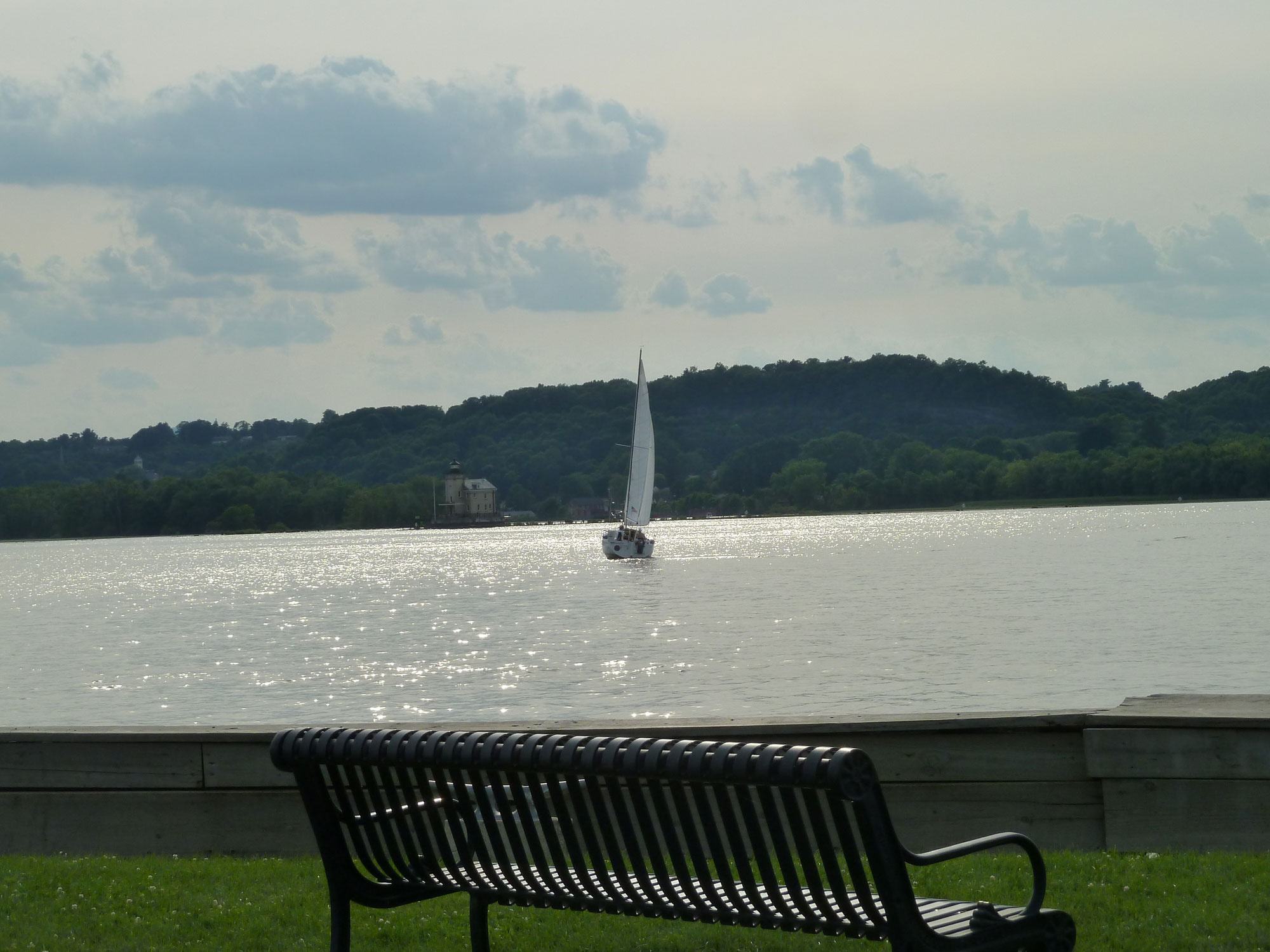
Rhinebeck, New York

Estates, villas, and a remarkable Hudson Valley legacy.

Rhinebeck Villas is an independent editorial site devoted to the architectural character, historic estates, village life, and river-facing landscape of Rhinebeck, New York. It approaches Rhinebeck not as a sales concept, but as a place where scenery, memory, craftsmanship, and cultural continuity still feel vividly connected.

A place-shaped journal of architecture, landscape, and Hudson Valley atmosphere.
Introduction

Why Rhinebeck deserves a site devoted to built form, memory, and place.

Some towns are pleasant. Some are picturesque. Rhinebeck is more than that. It has enough architectural density, enough historical depth, and enough visual distinction to justify sustained attention on its own terms. The village, the country houses, the bluff-top properties, the old roads, and the river views together create a setting that feels larger than the town’s scale and more layered than a quick weekend visit can reveal.

Rhinebeck belongs to that rare class of places where architecture is not merely a backdrop to life, but one of the principal ways the town expresses itself.

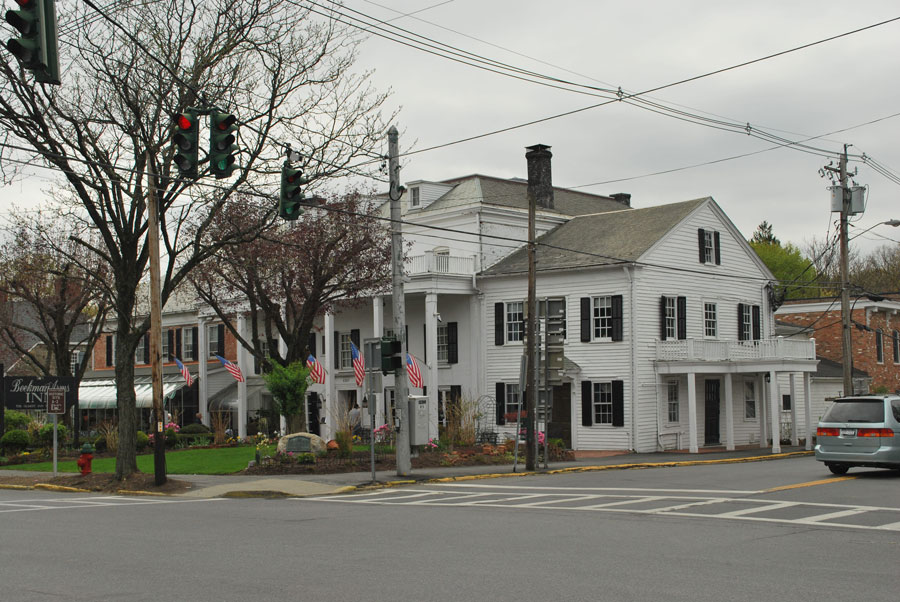
The interest begins in the village, where continuity matters. Historic inns, main-street facades, and long-used crossroads give Rhinebeck a civic center that still feels inhabited rather than staged. From there the story widens into the surrounding landscape: wooded drives, elevated views, stone houses, estate remnants, formal approaches, and broad relationships to the Hudson.

What makes Rhinebeck unusually rich is not simply that it possesses important buildings. It is that different kinds of buildings speak to one another. The public village and the private estate, the intact landmark and the evocative ruin, the cultivated grounds and the agricultural memory beneath them all remain legible at once. That legibility is what gives the town its atmosphere.

This site exists to notice those continuities and to present them with care. The goal is not exhaustive cataloguing. It is to provide a beautifully organized, historically informed introduction to why Rhinebeck continues to matter.

Editorial View

A cultural site first, and unmistakably so.

Rhinebeck rewards a cultural and architectural lens because it allows the place to be understood as a composition: street and landscape, social memory and building type, grandeur and restraint. That lens can sustain profiles, essays, photographs, and historical notes without ever collapsing into marketing language.

Design Character

Quietly luxurious, never overstated.

The visual direction of this page is meant to feel like a well-edited heritage journal: warm, spacious, typographically calm, and serious enough to let the subject carry its own dignity.

Notable Houses & Estates

Additional Rhinebeck properties that deepen the town’s architectural vocabulary.

Rhinebeck’s character does not rest on a single mansion or a single era. It emerges from a wider field of houses, estate fragments, village buildings, and adapted farm properties that show how the town evolved without losing legibility. These examples add depth to the opening portrait.

Historic photograph of Ferncliff estate in Rhinebeck, New York
Estate Legacy

Ferncliff

Ferncliff represents the grand estate tradition at its most expansive. The Astor property grew into one of the defining country-seat landscapes of the area, and even where the original estate has been divided, the name still carries the aura of Rhinebeck’s Gilded Age reach.

What matters culturally is not only the scale once associated with Ferncliff, but the way it reminds a visitor that Rhinebeck was part of a larger Hudson Valley world of cultivated grounds, private roads, formal houses, and deeply considered siting.

A reminder that Rhinebeck’s elegance has always included very large ambitions as well as smaller domestic beauty.
Jan Pier House along Route 308 in Rhinebeck, New York
Early House Type

Jan Pier House

The Jan Pier House shows another side of Rhinebeck: older, humbler in origin, and quietly transformed across centuries. Built about 1761 and later remodeled in the nineteenth century with a mansard roof, it demonstrates how Dutch-rooted stone-house culture and Victorian taste could coexist in a single surviving structure.

Houses like this matter because they keep Rhinebeck from becoming a one-note story of spectacle. They reveal continuity, adaptation, and the habit of reworking inherited fabric rather than abandoning it.

An example of Rhinebeck’s layered domestic history: colonial core, later embellishment, and continued presence in the landscape.
Exterior of Wilderstein mansion in Rhinebeck, New York
Architectural Presence

Wilderstein Exterior

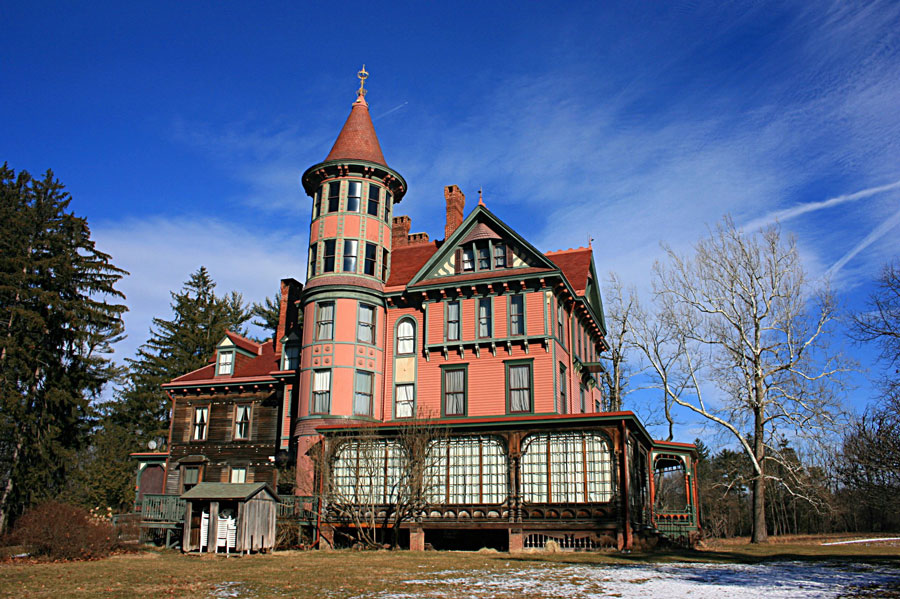
Seen from the outside, Wilderstein explains why Rhinebeck attracts people who care about silhouette, material, and setting. Its massing is picturesque without dissolving into chaos, and its ornament feels tied to the bluff-top site rather than imposed upon it.

Exterior views are important because they show how much Rhinebeck architecture depends on approach and revelation. The house does not simply stand on land; it stages an encounter between building, trees, grade, and river light.

Proof that Rhinebeck’s most memorable buildings are experienced as compositions in landscape, not isolated objects.

Stone remains a key local language.

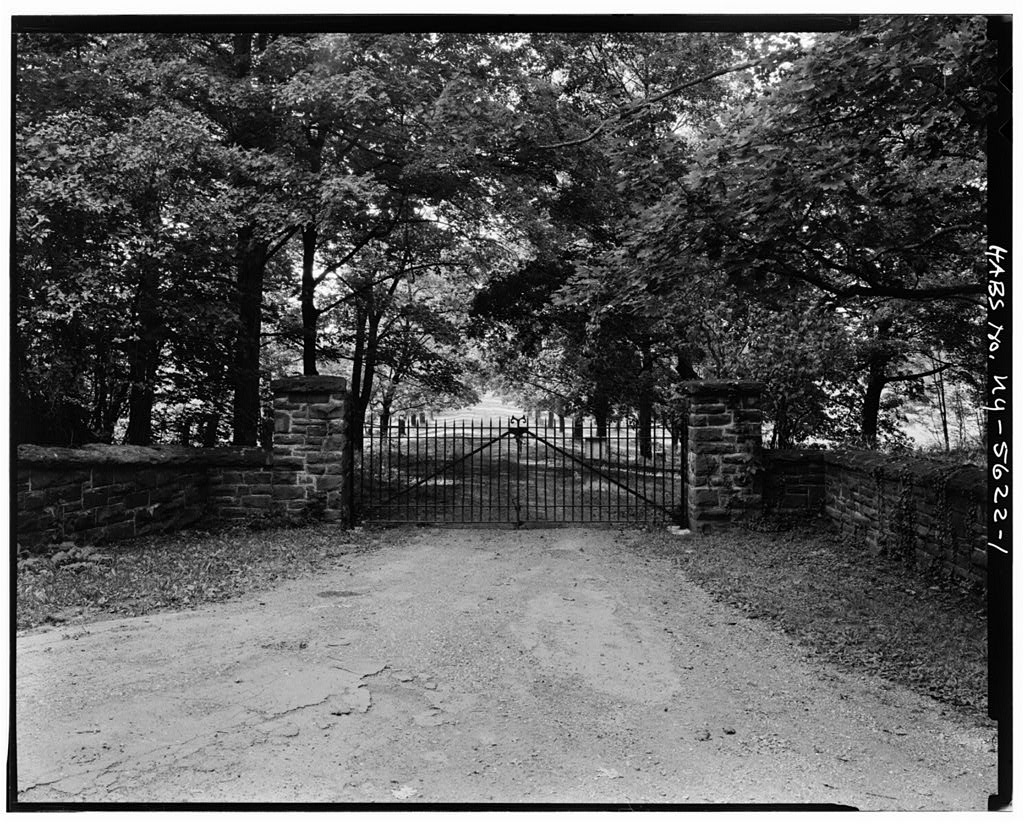
Rhinebeck’s older houses often derive their gravity from masonry, whether in full stone walls, foundations, gate elements, retaining walls, or garden structures.

Rooflines do more work here than one first notices.

Mansards, gables, dormers, and steep silhouettes shape the emotional reading of a house long before ornament comes into focus.

Approach is part of the architecture.

Drives, setbacks, tree canopies, and partial reveals make Rhinebeck buildings feel discovered rather than merely viewed.

Adaptation is part of the town’s beauty.

Rhinebeck’s built environment is compelling because different periods remain visible together instead of being flattened into a single style.

Architecture & Landscape

The recurring visual language of Rhinebeck.

Rhinebeck is best understood not through isolated monuments, but through repeated motifs that appear across houses, streets, and landscapes. The town’s coherence lies in those recurrences.

River-facing composition

In the Rhinebeck area, a building often feels planned in relation to light, overlook, and atmospheric distance. The river is not just a view; it is part of the emotional structure of the site.

Masonry and permanence

Brick and stone lend a sense of authority that feels right for the Hudson Valley. These materials make many Rhinebeck buildings appear rooted rather than merely placed.

Picturesque silhouette

Gables, towers, porches, verandas, and asymmetrical massing are common because many of these houses were designed to be approached as visual compositions, not simply entered.

Village and estate dialogue

Rhinebeck’s special quality lies in the coexistence of a walkable village public realm with a more secluded estate world beyond it. Each gives the other context and credibility.

Sense of Place

What makes Rhinebeck feel distinct from other beautiful towns.

Plenty of towns in the Hudson Valley are attractive. Rhinebeck is distinctive because beauty here is distributed across several scales at once: the inn, the main street, the country house, the bluff, the cultivated grounds, and the wider agricultural memory of the landscape.

Rhinebeck has the unusual advantage of being both visually refined and historically legible.

The village still reads as a place where people gather, dine, walk, and arrive. That matters because it keeps the town from drifting into abstraction. The larger houses and estate remnants around Rhinebeck are compelling partly because they remain tethered to a lived-in civic center.

There is also a particular kind of restraint in Rhinebeck that distinguishes it from more flamboyant resort settings. Even grand properties often feel mediated by trees, walls, setbacks, slope, and weather. The result is not spectacle for its own sake, but atmosphere accumulated through sequence and distance.

In practical terms, that means Rhinebeck rewards re-visitation. The place is rarely exhausted in a single glance. One comes first for the broad impression, then returns for textures: a stone wall, a porch line, a roof profile, a turn in the road, a view unexpectedly opened toward the river.

Rhinebeck is best encountered slowly.

The town reveals itself through transitions: from village sidewalk to shaded road, from open view to enclosure, from commerce to domesticity, from active landmark to remembered past.

Landscape is part of the architecture.

Trees, approaches, river outlooks, field edges, and even distance itself are part of how Rhinebeck’s major houses are understood.

Public and private beauty coexist here.

One can appreciate Rhinebeck through a village visit, a museum stop, a riverside perspective, or a historical reading; the place is not dependent on a single vantage point.

The town carries both polish and memory.

Rhinebeck’s elegance is convincing because it does not erase time. It accommodates weathering, adaptation, and the persistence of older forms.

Visiting Rhinebeck

How to approach the town if you are arriving for the first time.

Rhinebeck rewards attention more than speed. The right visit is not a rush from one attraction to another, but a measured encounter with streetscape, landscape, and the rhythm between them.

Begin in the village

Start with public life, not seclusion.

Walk the village center first. Notice storefront scale, historic facades, rooflines, street trees, and the way Rhinebeck’s central blocks still feel like a place to inhabit rather than consume. Beginning here gives the larger estate landscape a social and historical frame.

Then widen the lens

Read the edges and approaches.

The roads leading outward matter nearly as much as the destinations themselves. Rhinebeck often reveals its character in transitions: roadside stonework, tree canopy, set-back houses, changing light, and glimpses of larger landscapes beyond.

Leave room for stillness

The place is atmospheric before it is encyclopedic.

Do not treat Rhinebeck like a checklist. Its strongest impression often comes from proportion, pacing, and quiet visual memory: the sort of details that only register when you slow down enough to let the place disclose itself.

About This Site

An independent editorial site focused on Rhinebeck’s cultural landscape.

Rhinebeck Villas is an independently operated informational and editorial site focused on Rhinebeck, New York’s estates, villas, inns, architecture, village character, and surrounding landscape. It is not an official government, brokerage, developer, or project-marketing website.

The aim is simple: to present Rhinebeck as a place of enduring architectural and cultural interest, with language and design that respect the subject rather than flatten it.

This site favors careful prose, restrained visual presentation, and historically grounded observation. Its subject is not only a set of notable buildings, but the larger relationship among village form, river setting, estate history, preservation, and memory.

Over time, that approach can naturally support profiles of individual properties, seasonal essays, historical notes, photography, and curated source material, but the mission is already complete at the level of principle: to offer a serious, attractive, and independent introduction to Rhinebeck as a place worth studying.

Selected Sources

Foundational references behind this opening page.

The site is editorial in nature, but the historical anchors used here are grounded in public sources and official institutional material.

Wilderstein Historic Site

Wilderstein’s official history identifies the estate as a major Victorian site and notes that the first house on the property was ready for occupancy in 1853.

View source

Beekman Arms History

The inn’s official history traces the site to a traveler’s inn established in 1704, with the Beekman Arms addition dating to 1766.

View source

Wyndcliffe

Public historical sources identify Wyndcliffe as a Rhinebeck-area mansion built in 1853 that later became one of the Hudson Valley’s most evocative architectural ruins.

View source

Jan Pier House

Public historical sources describe the Jan Pier House as a c. 1761 stone farmhouse later remodeled in the Second Empire style and listed on the National Register of Historic Places.

View source

Rhinebeck Village Historic District

Public historical sources describe the district as a cohesive area of preserved buildings representing more than two centuries of Rhinebeck’s civic and architectural development.

View source